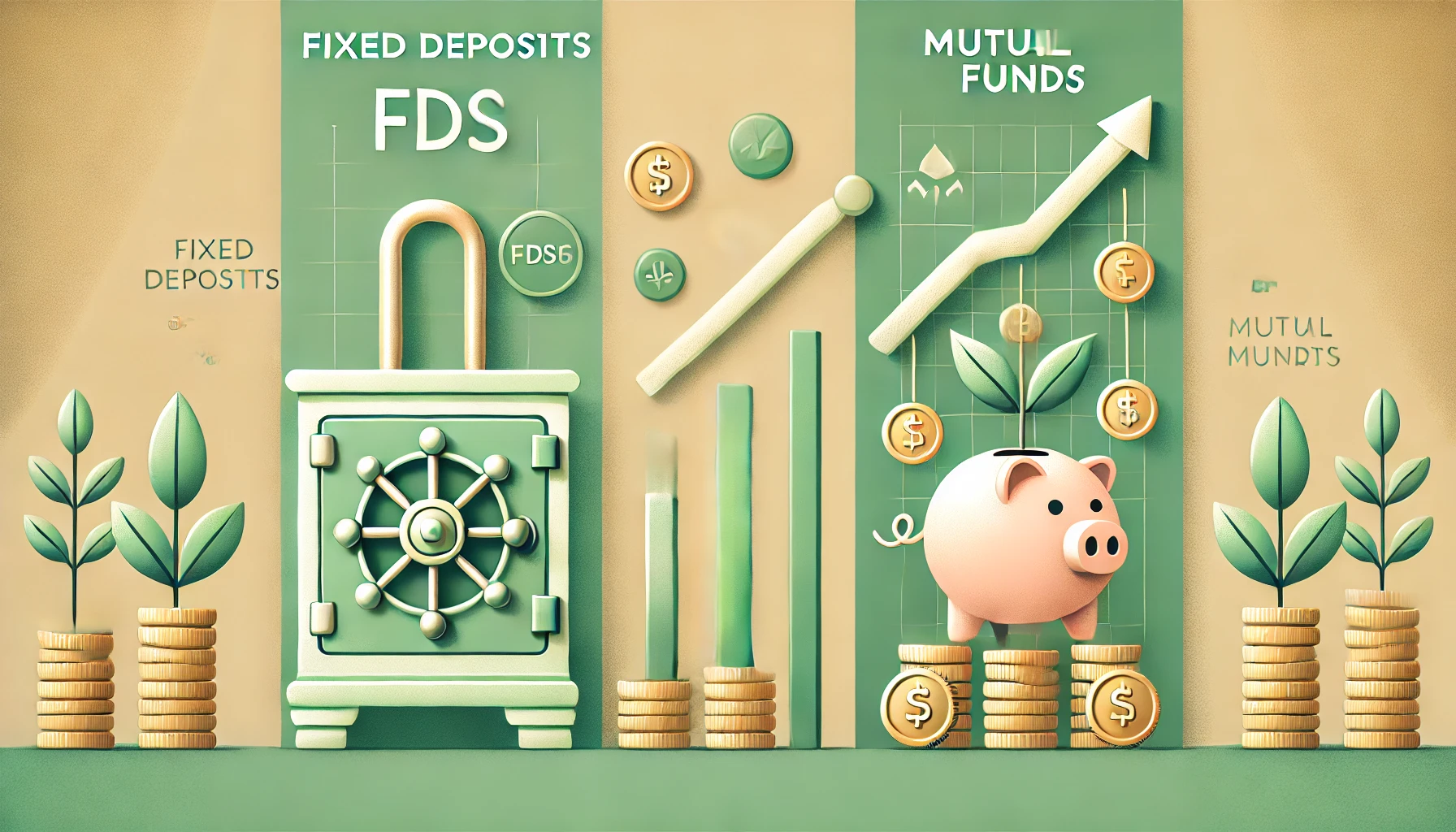

When it comes to investing, two popular options are Fixed Deposits (FDs) and Mutual Funds. Both help grow your money, but they work in different ways. Let’s break it down in simple terms.
What is a Fixed Deposit (FD)?
A Fixed Deposit (FD) is a safe investment where you deposit a lump sum of money in a bank or a Non-Banking Financial Company (NBFC) for a fixed period. In return, you earn a guaranteed interest rate. When the term ends, you get your original deposit plus the interest earned.
Benefits of Fixed Deposits:
- Guaranteed Returns: The interest rate is fixed, so you know exactly how much you will get at the end of the period.
- Risk-Free Investment: Your money is safe, as FDs are not affected by market ups and downs.
- Higher Interest than Savings Accounts: You earn more than what you would in a regular savings account.
- Flexible Tenure: You can choose a term ranging from a few months to several years.
- Tax Benefits: Some FDs offer tax-saving benefits under Section 80C of the Income Tax Act.
- Liquidity: You can withdraw your FD before maturity, but it may come with a penalty.
Who Should Invest in FDs?
- People who prefer safe and stable investments.
- Senior citizens looking for a secure income.
- Short-term investors who want fixed returns.
- Taxpayers who want to save tax with tax-saving FDs.
What is a Mutual Fund?
A Mutual Fund is an investment where your money is pooled with other investors and managed by professionals. The fund invests in stocks, bonds, or other assets, and your returns depend on market performance.
Benefits of Mutual Funds:
- Higher Return Potential: If the market does well, mutual funds can give you higher returns than FDs.
- Beats Inflation: Over time, mutual funds can grow your money faster than inflation.
- Diversification: Your money is spread across different investments, reducing risk.
- Professionally Managed: Experts handle your investments for you.
- Liquidity: You can buy and sell mutual funds easily.
- Flexibility: You can invest in a lump sum or through Systematic Investment Plans (SIPs).
Who Should Invest in Mutual Funds?
- People seeking higher returns than FDs.
- Investors who can handle some risk (as markets can go up and down).
- Long-term investors looking for wealth growth.
- Taxpayers who want to save tax through Equity-Linked Savings Schemes (ELSS).
FD vs Mutual Funds: A Simple Comparison
| Feature | Fixed Deposit (FD) | Mutual Fund |
|---|---|---|
| Returns | Fixed interest rate | Market-based returns |
| Risk | Very low | Varies from low to high |
| Expenses | No extra cost | Management fees apply |
| Liquidity | Limited (penalty for early withdrawal) | High (can withdraw anytime) |
| Investment Amount | Minimum required, no upper limit | Minimum required, no upper limit |
| Tenure | Fixed (1 to 10 years) | Flexible |
| Taxation | Interest is taxable | Taxed only when sold |
| Fund Management | No fund manager needed | Managed by experts |
| Regulated By | RBI | SEBI |
Example to Understand Better
Imagine two friends, Rahul and Amit. Rahul wants a safe and guaranteed return, so he puts ₹1 lakh in an FD at 6% interest for 5 years. After 5 years, he gets ₹1.34 lakh.
Amit is okay with some market risk and invests ₹1 lakh in a mutual fund. If the market performs well and grows at an average of 12% per year, his money grows to about ₹1.76 lakh in 5 years.
However, if the market performs poorly, Amit may end up with a lower amount than expected. But over a long period, mutual funds have historically given better returns than FDs.
Which One Should You Choose?
- If you want safety and fixed returns, go for an FD.
- If you want higher returns and can handle some risk, choose mutual funds.
- If you want to save tax, both tax-saving FDs and ELSS mutual funds are good options.
Ravi Chandra
Mutual Fund Distributor ARN-317654